This is the second of three articles about artificial intelligence. Part 1 established the baseline: the technology is already embedded in systems Americans depend on, and the pace of its development has outrun every institution designed to provide accountability. This article looks at what that pace means for how Americans work. Part 3 will be practical.
Within the last eighteen months, a new type of competitor has quietly entered the marketplace.
Consider the contractor who runs a small documentation company. Three employees. Federal clients. Every project delivered on deadline for eleven years.
Last month, a competing bid came in 60 percent lower.
The competitor was a one-person operation.
When the contractor asked how, the answer was a single sentence:
I use AI to do in four hours what takes your team four days to do.
That is not a forecast. It is a current market condition. And it is the kind of condition that first appears quietly — in bids, turnaround times, and staffing assumptions — before institutions develop language for what changed.
When one can do the work of four
Matt Shumer, CEO of HyperWrite AI and an industry insider, described the change in a February essay that received more than 80 million views.
His words are worth reading exactly as he wrote them:
“I tell the AI what I want, walk away from my computer for four hours, and come back to find the work done. Done well, done better than I would have done it myself, with no corrections needed.”
This is the sentence worth pausing on.
Not “AI helped me draft this.”
Not “AI gave me a starting point.”
The work — multi-step, judgment-requiring, standard-meeting work — was completed without supervision.
The system iterated on its own output. It corrected errors. It stopped when the result met the required standard.
What changed is not the capability.
It is the autonomy.
The rule behind the automation
To understand why this spreads so quickly, it helps to distinguish between two questions: what AI can do reliably and how organizations deploy that capability within real workflows.
Andrej Karpathy, former head of AI at Tesla and an early OpenAI researcher, offers one of the clearest frameworks for understanding which work changes first.
He calls it Software 2.0.
The principle is simple: AI automates tasks that are verifiable before it automates tasks that require open-ended judgment. If an output can be checked — if there is a correct answer, a passing standard, or a clear success condition — the process can eventually be automated.
A math problem has a correct solution.
A spreadsheet calculation either balances or it does not.
The same principle applies across professional work.
Software code either runs or it fails.
A contract either meets the standard or it does not.
A tax return is either correct or not.
Even many medical decisions ultimately resolve against test results or measurable criteria.
The more verifiable the work, the sooner it changes.
Karpathy’s framework runs counter to comfortable assumptions. The roles that feel most secure because they require expertise are often the most exposed — because expertise in verifiable domains is precisely what AI can now replicate at scale.
From tool to agent to orchestrator
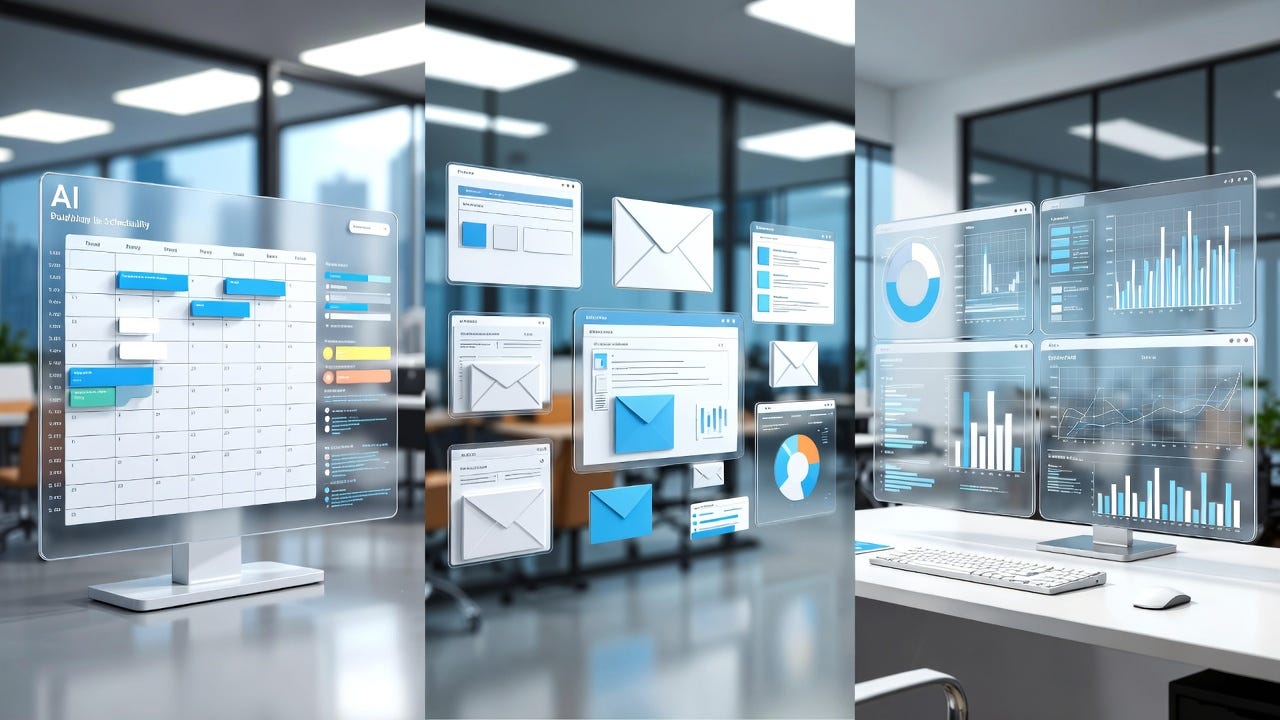
Chamath Palihapitiya describes the evolution through a simple sequence.
The first wave was a tool. AI assisted with drafts, searches, and first passes at a problem. Humans remained inside every step of the workflow.
The current wave is an agent. A system receives an objective and executes the work autonomously.
The next wave is orchestration. Multiple agents coordinate across tasks, systems, and information sources.
In practical terms, that means workflows that once required human oversight at each stage can now run from instruction to completion.
The instruction occurs in the morning.
The completed work arrives in the afternoon.
No one watching in between.
What sets this apart from earlier automation is its scale. A single system can run thousands or even millions of these workflows simultaneously.
Dario Amodei, CEO of Anthropic, describes the implications in striking terms. Imagine AI running as millions of simultaneous instances, operating ten to a hundred times faster than human researchers and analysts.
His phrase is memorable.
A country of geniuses in a datacenter.
Brian Roemmele, analyzing Anthropic’s usage data across industries, estimates that roughly 75 percent of a programmer’s tasks are already theoretically automatable.
High exposure follows in:
data entry (~67%)
medical records (~66%)
market research (~65%)
financial analysis (~57%)
customer service (~70%)
The shift is not that AI will ultimately perform this work.
The infrastructure to do it is already in place.
The compressing timeline
Elon Musk describes the transition in even starker terms.
He argues that the technological singularity is not a distant event but a process already in progress — a “supersonic tsunami” in which digital intelligence advances faster than institutions can react.
In his framing, AI first takes on cognitive labor. Physical tasks then follow through robotics.
Anything short of “shaping atoms” becomes vulnerable to automation.
That sequence matters.
It suggests that the disruption starts not on factory floors but within offices — in software development, research, administration, design, and other types of white-collar work. The same categories many Americans believed would stay protected from the kind of displacement that devastated earlier generations of industrial labor.
Musk is more optimistic than many of his peers about the long-term outcome. He believes abundance is possible: cheaper goods, abundant energy, less drudgery, and a world where work becomes less economically necessary.
But his timeline is aggressive.
He has suggested AI could exceed individual human capability across most domains by 2026, with superintelligence emerging around 2030.
Even if those dates prove early, the signal is clear.
Another major builder of these systems describes the shift as imminent, fundamental, and irreversible.
Who feels it first
Shumer is specific about the likely sequence.
Software engineering leads. AI development itself emphasizes this shift because coding is the area where technology advances most rapidly.
Other knowledge professions follow closely behind:
law
finance
medicine
accounting
consulting
writing and design
customer service
Physical sectors such as construction, manufacturing, and agriculture follow later as robotics matures.
The workers most exposed are not those at the bottom of the wage scale.
They are the entry-level credentials in professional fields.
These roles mainly serve to develop judgment. Most of their daily tasks involve structured, repeatable outputs — research memos, document review, data analysis, first drafts — the same tasks that AI systems now generate and verify effectively.
The profession itself may remain.
But the entry point changes.
The World Economic Forum, tracking workforce patterns across 55 economies, describes an emerging “occupational identity crisis” as a top global labor risk between 2026 and 2028.
The one thing experts agree on
At this stage, the debate is no longer about whether the shift will occur.
It is about how quickly.
Matt Shumer estimates meaningful disruption within one to five years.
Dario Amodei has warned that AI could surpass most humans at most tasks by 2026 or 2027.
Sam Altman describes a slower slope — disruptive, but gradual and ultimately manageable.
The disagreement is real.
They work with different data. They also make different assumptions about how quickly institutions — companies, schools, governments — adapt to technological change.
But the disagreement is narrower than it first appears.
They differ in pace.
They differ in timing.
They do not differ in direction.
The shift in structure — from tool to agent to orchestrator — is already happening. Not just a theory. Not a policy debate.
A current market condition.
You can see it in hiring decisions, productivity expectations, and the quiet restructuring of professional workflows.
And sometimes in something even simpler.
A contractor who spent eleven years building a reliable small business suddenly loses a bid to a one-person competitor — because work that once needed a team can now be completed in an afternoon.
Next week: Part 3 — Engaging on Your Terms. If you missed Part 1, you can find it here.