
This is the first of three articles on artificial intelligence. It explains what is happening now, why it matters, and what it means — in plain language.
Part 2 examines how this pace of change could affect the way Americans work and earn. Part 3 is practical: how to engage on your own terms.
Already inside
Artificial intelligence isn’t arriving someday; it’s already fixed in the infrastructure of daily life.
Consider the small business owner who runs a staffing firm in rural Tennessee.
For fourteen years, he used the same hiring process: phone screen, in-person meeting, reference checks. His judgment is the product. His word matters in the community.
Last year, the two major platforms he relies on for job listings changed the process. Applicants must now complete an AI pre-screening before a human ever sees their résumé — automated scoring, recorded interview prompts, and algorithmic ranking before a recruiter reviews the file.
He did not choose this.
His clients did not choose this.
It was a platform decision made by engineers in San Francisco and inserted upstream into the systems he depends on — before he even knew it was there.
What happened to him is not unusual. It is how this shift is arriving in American life: quietly, upstream, and without asking permission.
That is where we are with artificial intelligence.
Not at the door.
Already inside.
The comfortable assumption
The comfortable story goes like this: Artificial intelligence is a Silicon Valley issue.
Let the tech companies sort it out. The rest of us have real work to do — businesses to run, families to raise, communities to build.
For most of the past decade, that assumption was understandable. AI mostly appeared as something happening inside research labs or technology companies.
That option is no longer available.
Nobody voted on that either.
The technology is already embedded in the systems that govern everyday American life:
hiring platforms
credit decisions
news distribution
healthcare intake
government benefits processing
The debate about whether to engage has already happened — in rooms most Americans were never invited into.
The question is no longer whether artificial intelligence will affect your life.
The question is whether you will understand it when it does.
The signal in the documentation
February 5th mattered not because two companies released new models. Product launches happen constantly in the technology industry.
What mattered was the documentation.
On February 5th, 2026, OpenAI and Anthropic each released major new models. The releases themselves were not the story. The technical notes were.
OpenAI’s documentation for GPT-5.3-Codex included the following:
“GPT‑5.3‑Codex is our first model that was instrumental in creating itself. The Codex team used early versions to debug its own training, manage its own deployment, and diagnose test results and evaluations—our team was blown away by how much Codex was able to accelerate its own development.”
Read that carefully.
The AI helped build the AI.
When a system that helps design the next generation of models is itself improving each year, the pace of development is no longer limited by human engineers alone. Progress begins to compound.
Matt Shumer, a founder and AI investor, published a long essay about this moment on X. It received more than 80 million views in the weeks that followed. His essay was not a celebration.
It was a warning — framed as a briefing — about what that sentence in the documentation means for everyone downstream.
The autonomy curve
There is an organization called METR.
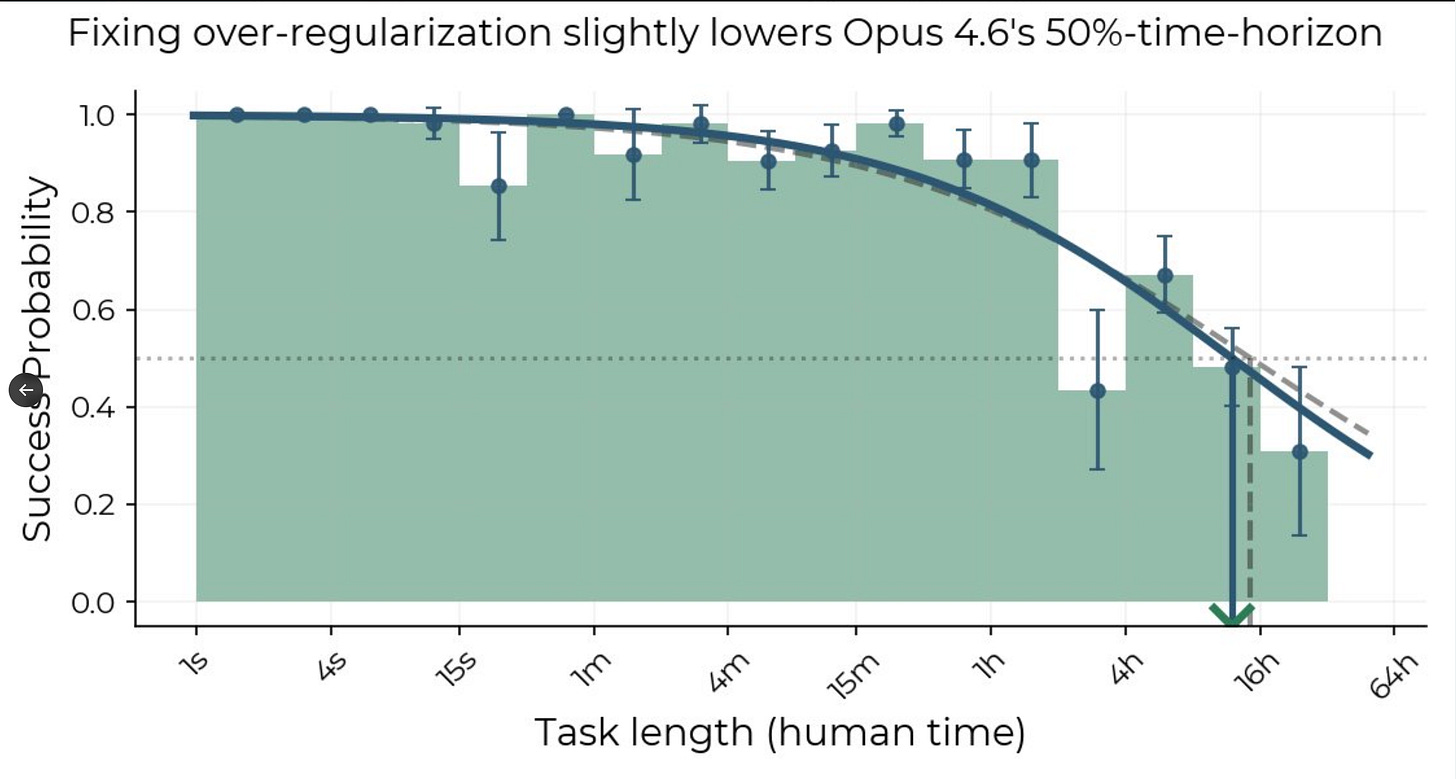
It measures one thing: how long a real-world task an AI system can complete on its own, from start to finish, without human intervention.
Think of it as measuring independence.
How much can the system do before it needs you?
A year ago, that number was roughly an hour.
Then four hours.
Then eight hours.
The most recent measurement (corrected for a modeling error) places it at 12 hours — roughly the equivalent of a full workday for a skilled professional.
And that number is not changing slowly.
From 2019-2025, it doubled approximately every 7 months; the most recent analysis shows it doubling every 4-5 months.
Not improving.
Doubling.
Every 4-5 months, the tasks these systems can complete without human involvement become twice as long and twice as complex.
Most of us are not tracking that curve. Neither are many of the institutions that would normally slow or scrutinize a shift of this magnitude.
But that is the pace at which this independence is being built — not by citizens who voted for it, not by a legislature that authorized it, but by engineers and investors moving faster than any oversight institution in this country has ever moved.
From tool to agent
Most Americans’ experience with artificial intelligence is the chatbot on a company’s customer service page.
The one you try to bypass to reach a real person.
That experience made AI seem irritating but optional.
That impression used to be accurate.
The window for it has closed.
The structural shift underway is from tool to agent.
A tool requires human oversight.
An agent takes direction and acts autonomously.
Systems already deployed today — not experimental, not in testing, already running in production — can execute multi-step workflows without human supervision. They read documents, make decisions, send communications, and update records in sequence.
The instruction happens in the morning.
The finished work arrives in the afternoon.
No one is watching in between.
For example: reviewing invoices, flagging anomalies, sending follow-up emails, and updating an accounting system — all automatically.
The chatbot you tried to avoid is not the technology you need to understand.
The agent that runs a workflow while you sleep is.
Across domains—simultaneously
And this shift is not limited to text systems or back-office automation.
The same acceleration is happening across every medium people use to work, create, and communicate.
Image generation moved from distorted output to work indistinguishable from professional photography in under three years. Advertising agencies and marketing teams are already using these systems for production visuals.
Video generation now produces synchronized audio — sound built alongside the visual rather than layered on afterward.
Music generation can produce fully licensed tracks in seconds.
Voice cloning now operates at near-human fidelity.
All of these capabilities reached production quality in roughly the same window.
This is not a technology maturing gradually in one lane.
It is a technology that can produce professional-grade work across every medium — text, images, video, audio, and autonomous action — simultaneously.
The implications for every field that produces anything are structural.
And they’re already here.
Who decided this?
If a technology is currently embedded in hiring systems, capable of executing hours-long tasks autonomously, and advancing simultaneously across every medium people use to produce work, one question becomes unavoidable.
Who authorized it?
No legislature approved it.
No constitutional framework governs the deployment.
No accountability mechanism exists for a technology now part of hiring decisions, credit approvals, content moderation, and government services.
A small number of companies — funded by a few wealthy investors — are building a system that will reshape the American workforce, the American economy, and the infrastructure of daily life.
And they are doing it at a speed that has outrun every institution designed to provide oversight.
Dario Amodei, CEO of Anthropic and a former senior researcher at OpenAI, is widely regarded as one of the AI industry’s strongest safety advocates. He left OpenAI in 2020 over concerns that commercial pressures and rapid scaling were outpacing safety safeguards, later founding Anthropic.
He has publicly predicted that artificial intelligence may eliminate 50 percent of entry-level white-collar jobs within one to five years — and that AI could reach a state of being “substantially smarter than almost all humans at almost all tasks” by 2026 or 2027.
Many people inside the industry believe that’s a conservative estimate.
This is not a partisan issue.
It is a consent issue.
And the people least positioned to see it coming are often the ones most exposed to its effects — workers, small business owners, and communities that depend on systems they do not control.
Before we go on
This is not a call to embrace the technology.
Part 3 will discuss its application in more detail.
This is a briefing.
The baseline before the conversation that matters.
Part 2 will examine what this pace means for how Americans work — which industries and job categories will be affected, and what the available evidence suggests about timing.
Part 3 will be practical. How to engage on your own terms in your field without becoming a technology enthusiast or surrendering your skepticism.
The goal is not to make you blindly accept artificial intelligence.
The goal is to ensure you are not the last to know about a system that’s operating all around you.
Coming Soon: Part 2 — what the speed of change means for how Americans work and earn.