
The safest career strategy of the last generation is quietly breaking down.
For about thirty years, Americans could build successful careers by occupying the space between creation and execution. They managed projects instead of building products, coordinated teams instead of producing output, and moved information between specialists who rarely spoke the same language. The middle became one of the safest places in the economy.
Today, that middle is beginning to disappear.
You didn’t have to own the company or build the product. Your job was to connect the people, information, and decisions that kept everything moving. Account managers, analysts, recruiters, coordinators, consultants, loan processors—they carried value from one side to the other and took a small cut for the trip.
That cut provided a good living for a long time.
As of this year, it’s under pressure.
The shift beneath the headlines
So what changed?
By the middle of 2026, software stopped being a tool you operate and started becoming a worker you assign. The new systems don’t just answer questions. They run errands. They read the inbox, draft the reply, pull the report, book the call, and hand you the finished result.
The numbers deserve a straight read. The May 2026 jobs report still showed growth: payrolls rose by 172,000, unemployment held at 4.3%, and most gains came in health care, hospitality, and local government.1
The headline isn’t collapse.
But look at where the early pressure is landing.
It falls first on coordination and pass-through roles: the relays whose job was simply to move work along. The hands-on trades and licensed professions are largely untouched so far. The electrician, the nurse, and the welder still get the call.
The squeeze is in the middle.
AI isn’t the only force shaping the labor market. Energy costs, trade disputes, and changing demand matter too. Even so, the structural pull is already clear enough to act on.
The stories you’re being sold
That is the fact.
Now watch how you’re being told to feel about it.
You’re handed two stories.
The first is panic. “AI is coming for all the jobs.” Learn to be afraid—then learn to be small.
The second is hype. “Learn to prompt, and you’ll be fine.” Buy the course, memorize the tricks, and ride it out.
Both stories hide the same reality.
Neither tells you where the value actually went. It didn’t disappear. It moved. It drained out of the middle and pooled at the two edges, where the market is still paying in full.
The middle was never as secure as it felt. A relay job is a rented job. Its value comes from the position, not the person. You get paid because you occupy a useful spot, not because you do something only you can do.
That works until something cheaper can occupy the same spot.
This year, something cheaper showed up, and it works around the clock.
This matters for more than your paycheck. When your income depends on being a pass-through, you’ve quietly handed your security to a box on an org chart. You didn’t build a durable asset. You inherited a position.
Anyone above you with a budget and a new tool can remove it.
That was always the deal.
Where the value went
So where did the value go? To the edges.
There are two.
One edge is the operator: the person who does the work and owns the outcome. The builder, the closer, the maker—the one who can pick up these new tools and run an operation that once required a small team. Operators drive the machine rather than fear it, and demand for them is rising.
The other edge is the principal: the person whose judgment, reputation, and accountability the market trusts. The one a client calls because they want his assessment, not a summary they could generate themselves. The surgeon you’d fly across the country for. The lawyer you’d wait three months to hire.
You can’t automate the person willing to be responsible for the answer.
The same signal is hiding in plain sight. Through June 2026, while headlines argued about robots, the White House repeatedly highlighted people doing tangible work: truckers “keeping America running,”2 farmers whose livelihoods it pledged to defend,3 and workers connected to retained coal plants and domestic energy.4 Whatever you think of the politics, the underlying signal matches the labor data.
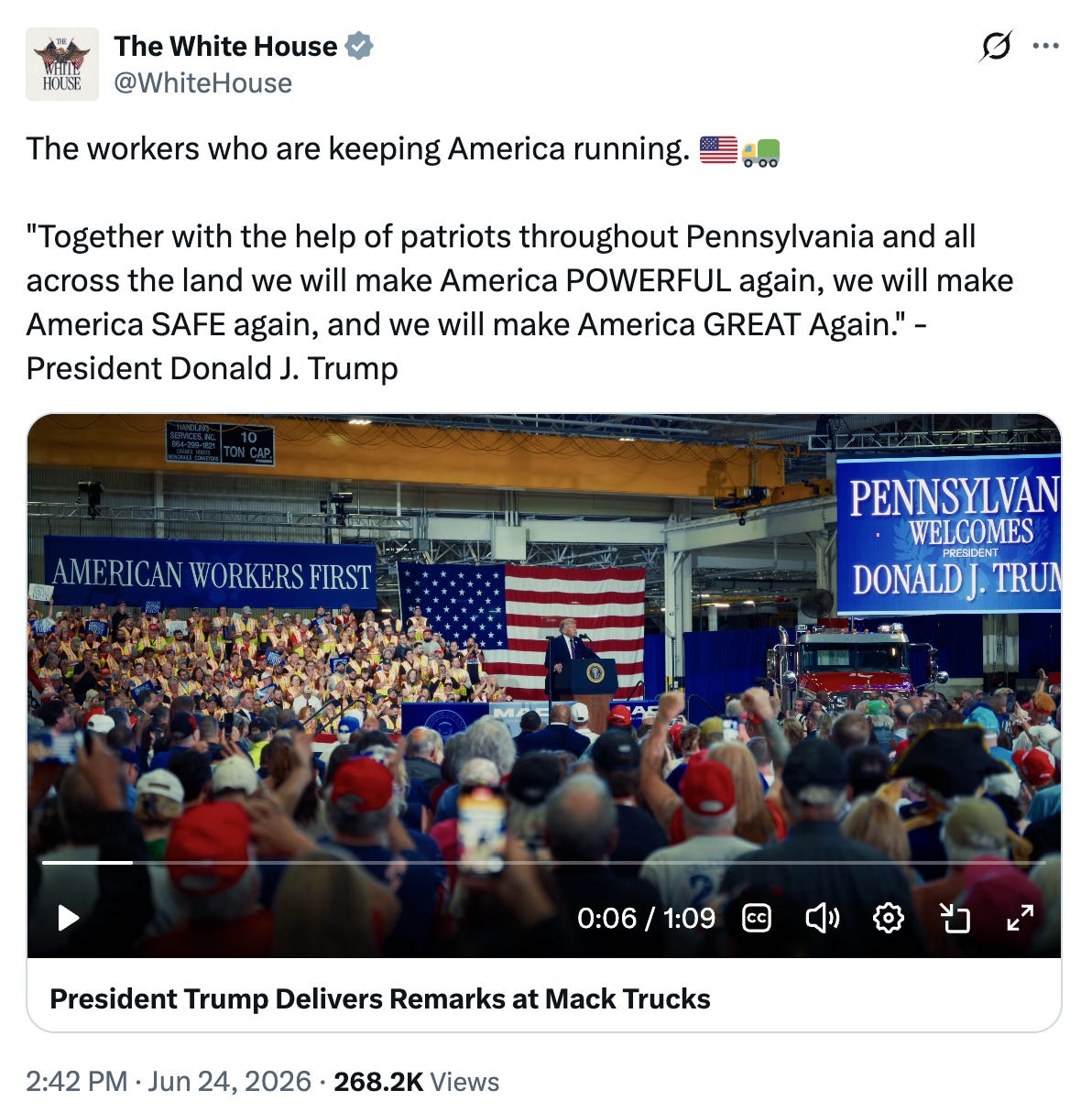
Value is flowing toward people who own real outcomes and away from desks that simply route paperwork between them.
Both edges share one trait. They own something.
The operator owns the outcome. The principal owns the judgment. The middle owned neither.
That’s why the middle is going first.
Pick an edge
So what do you actually do?
Stop trying to predict the market and start positioning on principle. Prediction is a guess about where jobs land next year. Principle is a decision about who you’ll become regardless of where the tools go.
Only one of those is in your hands.
If you’re in the middle today, you still have room to move.
The pressure is early, and early is the cheapest time to act.
Pick an edge.
If you lean operator, get dangerous with the tools—beyond the party tricks. Learn to deliver a real outcome from start to finish: a launch, a product, a campaign, built with a small stack and your own two hands.
Own a result someone will pay for.
If you lean principal, build the one thing no machine can hand over: a track record, a point of view, and the willingness to put your name on the call. Sharpen your judgment in public and become the person others bring the hard questions to.
Most people will become some mix of both.
That’s fine.
The direction is the same: toward an edge, toward ownership, and away from merely passing value along.
The real story
Here’s the quieter version of this shift.
The hollowing-out of the middle isn’t really a story about technology. It’s a story about agency. For a generation, many capable people outsourced their security to a position and called it a career.
The tools simply made the bill come due sooner.
A sovereign person doesn’t wait to see which way the layoffs break. She decides what she’ll own, builds it deliberately, and stops renting her future from an org chart.
The middle is being hollowed out. The edges are being paid in full.
Own an edge.