
This is the third of three articles on artificial intelligence. Part 1 established that AI is already embedded in the systems Americans depend on. Part 2 showed what that pace means for how Americans work. This one delivers on that promise directly.
The result that changes the frame
It’s easy to underestimate a shift that does not yet feel real.
In March 2026, Anthropic — one of the companies building the AI systems discussed in this series — published a research paper on the labor market. The authors gave it a characteristically dry title: “Labor market impacts of AI: A new measure and early evidence.”
It received almost no attention outside specialist circles. That is a mistake. Because buried inside that paper is a finding almost nobody is talking about — one that meaningfully changes the conversation for anyone reading this series with a knot in their stomach.
The finding:
As of early 2026, there is no measurable increase in unemployment for workers in the most AI-exposed jobs.
The researchers — using Anthropic’s own usage data matched to federal labor surveys — found that since ChatGPT’s release, the unemployment gap between highly exposed and non-exposed workers is “small and insignificant.”
That is not a typo. That is the company building the technology telling you what its data shows.
Where exposure is real
Strip this down to mechanics. The claim that “AI will eliminate your job” requires three things to be true at the same time.
The tasks in your role must be theoretically automatable.
Those tasks must be seeing real-world automated use right now.
Automation must translate into fewer hires or lower unemployment in your field.
Anthropic’s research tests all three conditions — not with projections or models, but with actual usage data from millions of real conversations, matched to federal occupation surveys.
Here is what they found.
First, the workers most exposed to AI disruption in this study are not who most people picture. They are older, more educated, and earn roughly 47 percent more than workers in low-exposure roles. They are concentrated in knowledge work — not in trades, agriculture, or construction. This disruption, unlike the factory automation of the 1980s, is running uphill first.
Second, yes, AI can perform a significant portion of tasks in many professional jobs. Computer programmers top the list at roughly 75 percent exposure in observed usage data. Customer service representatives, data entry workers, financial analysts, and medical records staff follow closely.
Third, real-world use is running far behind capability. Even in computer programming — the most exposed category — observed coverage sits at 33 percent. The gap between what AI could do and what it is actually doing in the workplace is wide. And the researchers note that many tasks remain entirely beyond AI’s reach: physical work, legal representation, clinical judgment, and skilled trades.
Fourth, and this is the part the headlines miss — that theoretical and actual exposure has not yet translated into measurable unemployment. Not for the overall workforce. Not for the most exposed occupations.
There is one exception worth naming honestly. The researchers found tentative evidence that hiring of workers aged 22–25 into highly exposed jobs has slowed by roughly 14 percent since ChatGPT’s release. That signal is real. Entry-level white-collar roles are changing first. But even that finding comes with a significant caveat: those young workers may be staying in their existing jobs, taking different roles, or returning to school — rather than becoming unemployed.
The disruption is real. The timeline is slower than the loudest voices suggest.
What the story leaves out
Now consider what you’ve heard.
The dominant narrative goes like this: AI is an unstoppable wave. Resistance is futile. Either embrace it fully or be swept aside. The winners will be those who adopt the fastest; the losers will be those who hesitate. Every day you wait is a day you fall further behind.
That story is useful to some. It creates urgency. It drives adoption. It sells subscriptions and consulting engagements. And like most effective narratives, it contains a portion of truth.
But it is not the whole picture. And the part it leaves out matters enormously.
Two types of work
Here is a straightforward explanation of why.
Think of any professional workflow as a chain with two kinds of links: verifiable links and judgment links.
A verifiable link is a task with a correct answer — code that either runs or fails, a form that is either complete or missing a field, a calculation that either balances or does not. AI is genuinely good at these. It can automate them reliably, and the costs of error are low because the error is immediately visible.
A judgment link is a task that requires reading a room, weighing incomplete information, managing a relationship, or making a call that cannot be checked against a clean success criterion. AI can simulate these. It cannot reliably perform them under real-world conditions. And the cost of a silent error — one that looks correct but is wrong — is high.
Consider a home inspector. He can use AI to generate a report template in seconds — that is a verifiable task. But the judgment call about whether a foundation crack is cosmetic or structural, made while standing in a basement with a homeowner watching, is not something any system can reliably replicate. His value was never the paperwork. It was always the call he made.
The governing principle
AI automates the verifiable work before it reaches judgment. Workflows that are mostly verifiable change fast. Workflows where judgment is load-bearing change slowly or not at all.
This is why the labor market data looks the way it does. Many professional roles appear highly exposed on paper because they contain verifiable tasks. But those same roles often depend on judgment for their core value. The automation takes out the drudgery. It does not automatically take out the professional.
It also explains the one group showing early strain: entry-level workers whose primary job is producing verifiable outputs. First drafts. Data pulls. Document review. AI now handles all of these reliably. The profession does not disappear—the entry point changes.
The cost of waiting
If the disruption is slower than claimed, why engage at all? Why not simply wait and see?
That is a fair question. Here’s the answer.
The Anthropic researchers found that while unemployment in exposed occupations has not risen, the Bureau of Labor Statistics projects slower employment growth for those same occupations over the next decade. For every 10-percentage-point increase in AI task coverage, projected job growth drops by about 0.6 percentage points. That is not a crisis number. But compounded across a career, it represents real pressure.
More specifically: 50 percent of technology job postings now require AI familiarity. Skilled workers with AI proficiency are earning roughly 28 percent more than peers without it. The gap between those with access to AI tools and those without is widening — not in terms of unemployment, but in terms of leverage, options, and earning power.
The shift is gradual, but the constraint is real. Employers are selecting for AI-familiar candidates. Platforms are embedding AI before workers ever see it. Workflows are restructuring around AI output. Workers who disengage do not fall off a ledge — they lose ground incrementally.
That’s not a cliff. It is a slope. And slopes are easier to navigate when you see them coming.
The second cost of pure avoidance is subtler. As Part 1 of this series described, AI is already embedded in hiring platforms, credit systems, healthcare intake, and government services — often without any visible label. A worker who avoids engaging with AI does not avoid AI’s effects. They lose the ability to recognize, question, or push back against those effects when they encounter them.
Understanding a tool is not the same as surrendering to it. It is what gives you standing to say, “This decision was made by an algorithm, and I am asking for a human review.”
What skepticism gets right
The concerns are legitimate.
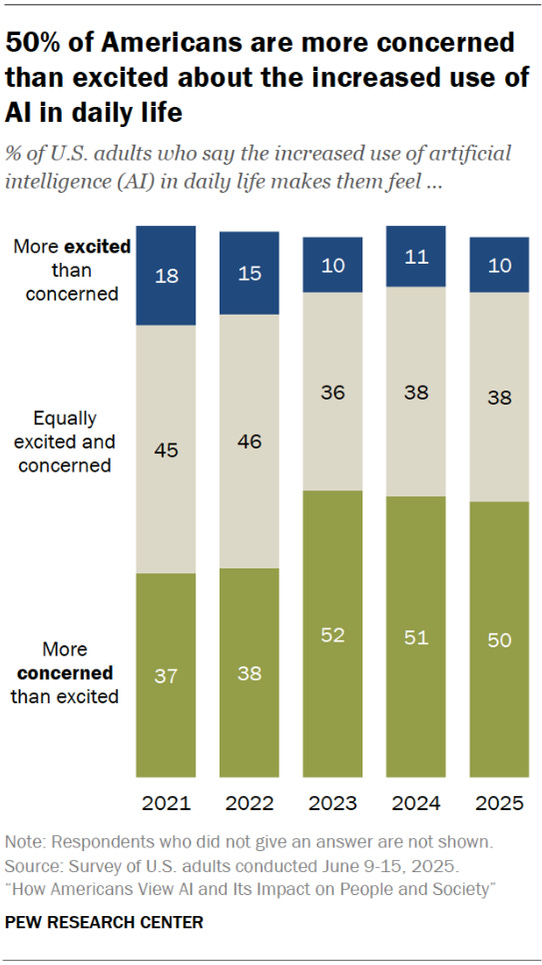
Privacy risks are real. Bias in AI-driven hiring and lending decisions is documented. The companies building these systems are not neutral parties. The pace of deployment has outrun any meaningful oversight. These are not paranoid concerns. They are structural facts.
Even so, the real question is not whether to trust the technology. The decisive question is whether you understand it well enough to protect your interests when it operates around you.
Skepticism is a posture, not a strategy.
The people who will fare best in the next decade are not necessarily the most enthusiastic adopters. They are the ones who understand what AI can and cannot do — and use that knowledge to make clearer decisions.
Who feels it first
If current trends continue, the outcome will not be equal.
Entry-level white-collar workers will feel it first. Fewer openings. Higher expectations. Less time to prove value.
Mid-career professionals are, for now, more insulated. Experience compounds into judgment. And judgment is still difficult to automate.
Ultimately, the risk is not simply who uses AI and who does not. But a skills gap and a resource gap.
For workers in physical trades, the timeline is slower. The Anthropic data shows near-zero current exposure in these roles. That buffer is real. But it is not permanent.
Map your work
You do not need to become an enthusiast to respond to this moment. You need a few practical advantages.
Understand the vocabulary.
You do not need to use AI tools to understand what they do. Learn the basics — what a large language model (LLM) is, what it cannot do, how “hallucination” works, and what automation versus augmentation means in practice. This vocabulary is now infrastructure.
Audit your own workflow.
Look at your daily work and identify which outputs can be checked against a clear success criterion. These are the tasks most likely to be displaced first — and the ones most worth understanding.
Investigate where AI is already operating.
Hiring platforms. Performance tools. Scheduling systems. These are no longer abstract. Ask direct questions: which systems are used, and how do they evaluate you? Are any outputs scored, filtered, or flagged by AI?
Start in low-risk environments.
Begin where the stakes are low. Many large language models (e.g, Grok, ChatGPT, Claude, Gemini) offer free tiers. Experiment with familiar, low-risk tasks. Avoid personal data. Focus on work where you can anticipate the outcome. Practice across multiple tools — each has different strengths and limitations.
The bottom line
Here is what these three articles come down to.
AI is already embedded in the systems that shape your hiring, your credit, your healthcare, and your news. It is improving faster than oversight can keep up. And it is being deployed by a small number of powerful companies whose incentives often do not align with yours.
The early labor market data — from the company building one of the most widely used systems — shows that catastrophic job loss has not arrived. The disruption is real, but slower than the loudest voices suggest. Experience and judgment still hold their value. The entry point is shifting, not the profession itself.
But slower is not the same as stopped. And a slope you can see is one you can navigate.
You do not have to trust the companies behind AI. You do not have to become an early adopter or an evangelist. And you do not have to surrender your skepticism.
You are only required to understand it well enough to protect what matters.
Your livelihood. Your family’s options. And your right to ask — of any system that has already made a decision about you — who made that call, and how.
That is not an embrace. It is a defense. And right now, it is the most practical thing you can do.
You decide
Some readers will take this into their work mapping which parts of their job require judgment that no system can replicate, and build from there. The asset was never the task. It was always the call.
Some will take it into their households, looking more closely at what their children are being taught and what tools their families are using.
Others will take it into their civic lives, learning enough to ask harder questions of school boards, local governments, and employers who are already deploying these systems with little public scrutiny.
None of these paths requires enthusiasm for the technology. All of them require the one thing AI cannot manufacture: your judgment about what matters.
That judgment is not a gap waiting to be filled by a machine. It is the asset. It always has been—and it still is.
ICYMI
Can You Avoid Artificial Intelligence? | Part 1: What’s happening — and why opting out may not be as simple as it sounds
The Bid That Was 60% Lower | Part 2: Silent signals that the AI economy has already started