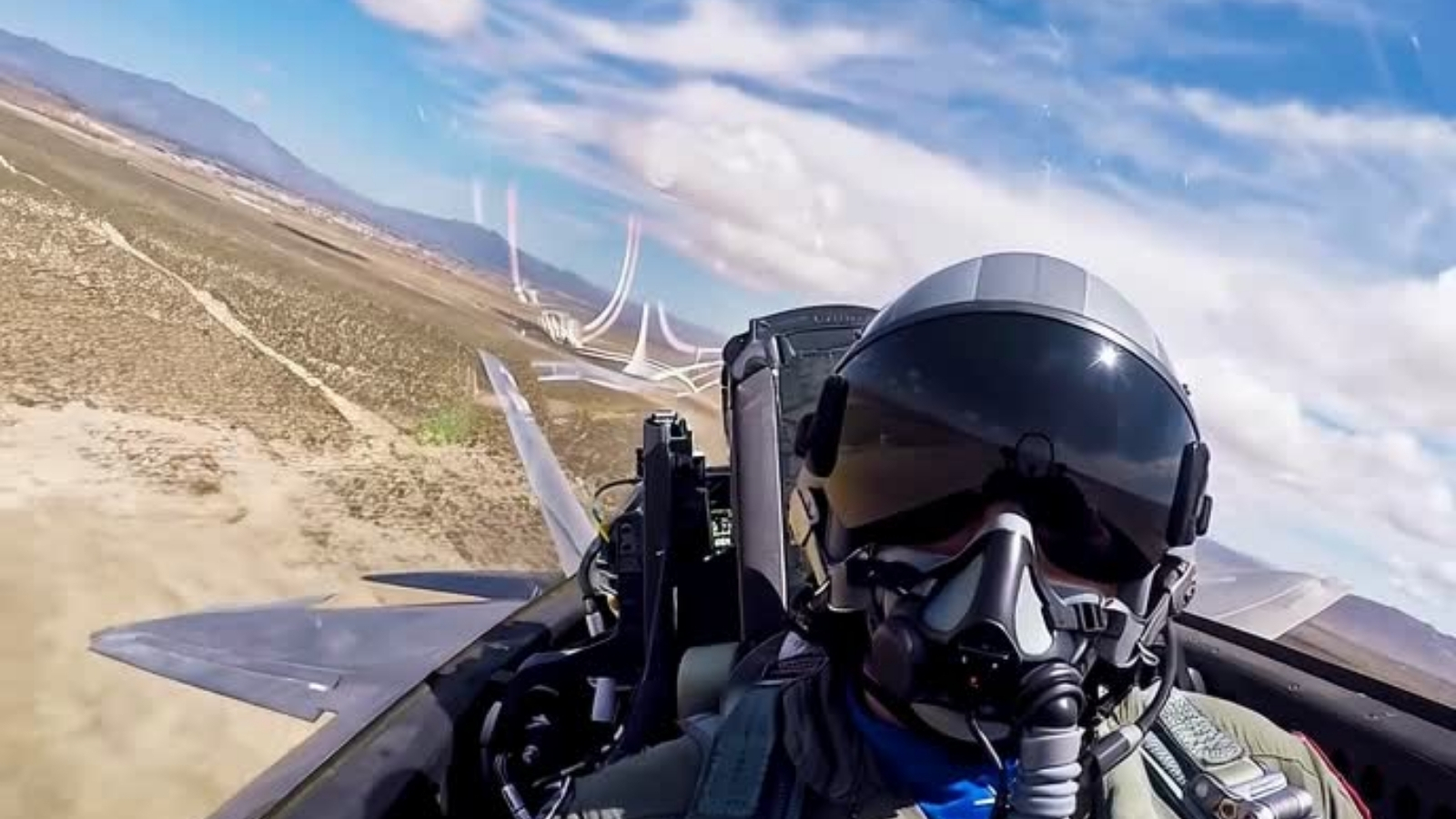
An F-22 test pilot once stood before a room of MIT students and told them something that sounded backward. In some ways, he said, a Cessna is harder to fly than an F-22 Raptor.1
The Cessna is the small propeller plane in which generations of pilots learned to fly. The Raptor is one of the most sophisticated fighter aircraft ever built. And the cheap one is the hardest to fly.
The pilot was Lt. Col. Randy “Laz” Gordon, a former F-22 squadron commander who had flown 76 different aircraft by the time of his MIT lecture.2 His point was that skills still matter. The basic principles transfer directly from one aircraft to the other; what changes is how much complexity the machine absorbs for you.
That pattern reaches well past the runway.
We are entering an age of tools that can calculate, analyze, write, code, and recommend in seconds. Difficult work can now look almost effortless, raising a more important question than what the tool can do:
What do you have in your hand?
The plane that flies itself
Start with why the Raptor can feel easier. In a small conventional airplane, the pilot is close to the mechanics of flight. Move the controls, and the airplane responds. The mistakes are yours, right away.
The F-22 puts computers between the pilot’s input and much of what the aircraft does. The pilot commands an outcome; the flight-control system translates it into the control-surface and thrust-vectoring movements needed to achieve that outcome.3 The pilot does not manually coordinate every adjustment. The system does.
In aerial-combat mode, the pilot can command a G level, and the aircraft will hold it even after the pilot eases off the stick. The system continually manages control surfaces, aircraft limits, fuel balance, and other variables. Even with the engines shut down, permanent-magnet generators can power the flight controls as long as the turbines continue to windmill.
All that automation changes what the pilot can focus on. He is no longer preoccupied with the mechanics of flying; his attention can shift to his wingmen, the threat, the mission, or what happens next. The technology has absorbed enough of the workload to change what’s required of the pilot.
But there is no magic gap between the Cessna and the Raptor. The expensive jet does not erase what the less expensive plane teaches.
It runs on top of it.
When capability looks like competence
The same is true far beyond aircraft. A powerful tool can unlock abilities you never had. It can't give you the understanding to know when to use it or whether the result holds up.
Give an experienced pilot a machine that can withstand G-forces and make thousands of adjustments faster than any human, and you extend what that pilot can do. Give the same machine to someone who has never learned to fly, and you have not created a pilot. You have created a confused passenger who’s in over his head.
The problem is that this distinction is becoming harder to see. Older tools often revealed what you didn’t know. A blank page showed whether you could write. A column of figures showed whether you understood the math. Difficulty itself revealed the limits of the person doing the work.
The new tools can conceal them.
A person can now produce a polished essay without knowing how to build an argument, write working code without understanding why it works, or ask a machine to analyze an investment without recognizing a bad assumption buried in the answer. The output arrives clean, confident, and complete enough to accept.
That is the risk. As tools become easier to use, competence becomes harder to see.
Technology can multiply skill. It can also increase errors and weaken assumptions just as quickly. The appearance of mastery is now available to people who have not done the necessary work to recognize when the output is wrong.
Long before computers entered cockpits, a man facing a task far beyond his ability was asked a much simpler question: What is that in your hand?
Hold that thought.
Calculation is the easy part
The principle holds in a place far less dramatic than a fighter cockpit: your money. An X post made the point with several classic financial equations: compound growth, present value, real return, and the Rule of 72.4 None requires a supercomputer. Luca Pacioli described what we now call the Rule of 72 in his 1494 Summa de Arithmetica: divide 72 by an annual interest rate, and the result is roughly the number of years it takes money to double.5
The formula is simple. Knowing when it matters is more valuable.
Consider $100,000 compounding for forty years. At 8 percent annually, it grows to roughly $2.17 million. Reduce that return by two percentage points—to 6 percent—and the balance falls to about $1.03 million. Two percentage points may sound small, but the difference is more than $1 million.
It’s no longer necessary to do that calculation by hand. AI can run it instantly. It can compare mortgage scenarios, calculate compound growth, adjust the rate of return for inflation, and model the effect of fees before you finish your coffee. That is an extraordinary advantage.
But a machine cannot help with a calculation you never thought to request. And someone who doesn't understand the assumptions behind an answer may have no way to distinguish an accurate result from one that appears correct.
This is where the value of experience is shifting. The advantage increasingly lies in knowing which calculation matters, which assumptions belong in it, what is missing, and when the answer requires another look.
Ease of production may mask a lack of competence.
The hardest part is letting go
Which brings up the harder problem: trust.
Gordon described the strange adjustment required when flying an aircraft whose control system handles so much of the work. A trained pilot is tempted to keep correcting, to keep working the stick—even when the airplane is already doing what it’s supposed to do. Sometimes the hardest thing is knowing when not to interfere.
The danger of getting that relationship wrong is not theoretical.
In 1992, a YF-22 prototype experienced severe pilot-induced oscillations after its landing gear was retracted during a low approach at Edwards Air Force Base. The aircraft struck the runway gear-up, skidded several thousand feet, and caught fire. Fortunately, test pilot Tom Morgenfeld escaped with only minor injuries. Investigators later found that a change in pitch-control response between the gear-down and gear-up configurations, combined with control-surface rate limiting, contributed to the crash. Changes to the flight-control software corrected the problem before the F-22 entered production.6
The lesson is more complicated than “trust the machine.” Blind trust would be foolish, and so would refusing to trust it at all. The greater skill is calibrated trust: recognizing what a system does well, understanding its limits, and knowing the task well enough to catch it when something goes wrong.
A seasoned pilot can let the aircraft handle much of the workload because he knows what the right feel is. Hand that same trust to someone who never developed the instinct, and it is not confidence.
It is surrender disguised as confidence.
The decision is still theirs. They have simply gone to sleep at the moment it is made.
That is the underlying temptation of a good tool. It lets us stop paying attention when attention matters most. The investor who does not understand compounding may accept the projection on the screen. The person who never learned the shape of a good argument cannot feel it when the machine hands back something that sounds good but is still incorrect.
Delegation is not abdication. We can delegate calculations, research, first drafts, and routine work, but responsibility does not travel with the task.
What is that in your hand?
When God called Moses to lead Israel out of Egypt, Moses saw every reason he was not the man for the job. He questioned whether he was the right person to confront Pharaoh. He worried that Israel would not believe him and insisted that he was not eloquent enough to speak.
God did not answer with a list of qualifications. He asked him a question:
“What is that in your hand?”
Moses looked at what he held.
“A rod.”7
A shepherd’s staff. Ordinary, familiar, present.
God did not ask Moses what he wished he had. He began with what was already in his hand and gave it a purpose Moses could not have supplied himself. A few verses later, as Moses returns to Egypt, Scripture calls that ordinary shepherd’s staff “the rod of God.”
Moses did not discover hidden greatness. He knew his limitations and named them repeatedly. The power was God’s; the rod was in his hand.
There is a difference between believing you are sufficient and recognizing what has been entrusted to you.
That difference matters in an age obsessed with what the newest machine can do. A more powerful tool does not erase what came before it. Instead, it makes what you bring to the tool more consequential.
You bring what the years have taught you: the discernment of a professional who has watched hundreds of deals go sideways; the instinct of someone who has built a business, raised children, closed a sale, or recovered from serious mistakes.
Experience is not automatically wisdom. Years can deepen discernment or merely harden habits. The advantage goes to the person who paid attention.
The machine can calculate the return, but it did not sit across the table from the client whose numbers looked perfect until the deal collapsed. It can generate ten recommendations, but it did not develop the instinct that tells you which one deserves a second look.
Do not confuse the disappearance of effort with the loss of expertise.
Ecclesiastes puts the instruction plainly:
“Whatever your hand finds to do, do it with all your might.”8
Look at what you have in your hand. Then put it to work.
The machine can calculate faster, produce more, and handle loads that once took hours of human effort. Use it. But keep what was always yours: the discernment to know what matters, the experience to recognize when something is wrong, and the responsibility to make the final call.
Powerful tools do not diminish the value of expertise. They reveal why it matters.