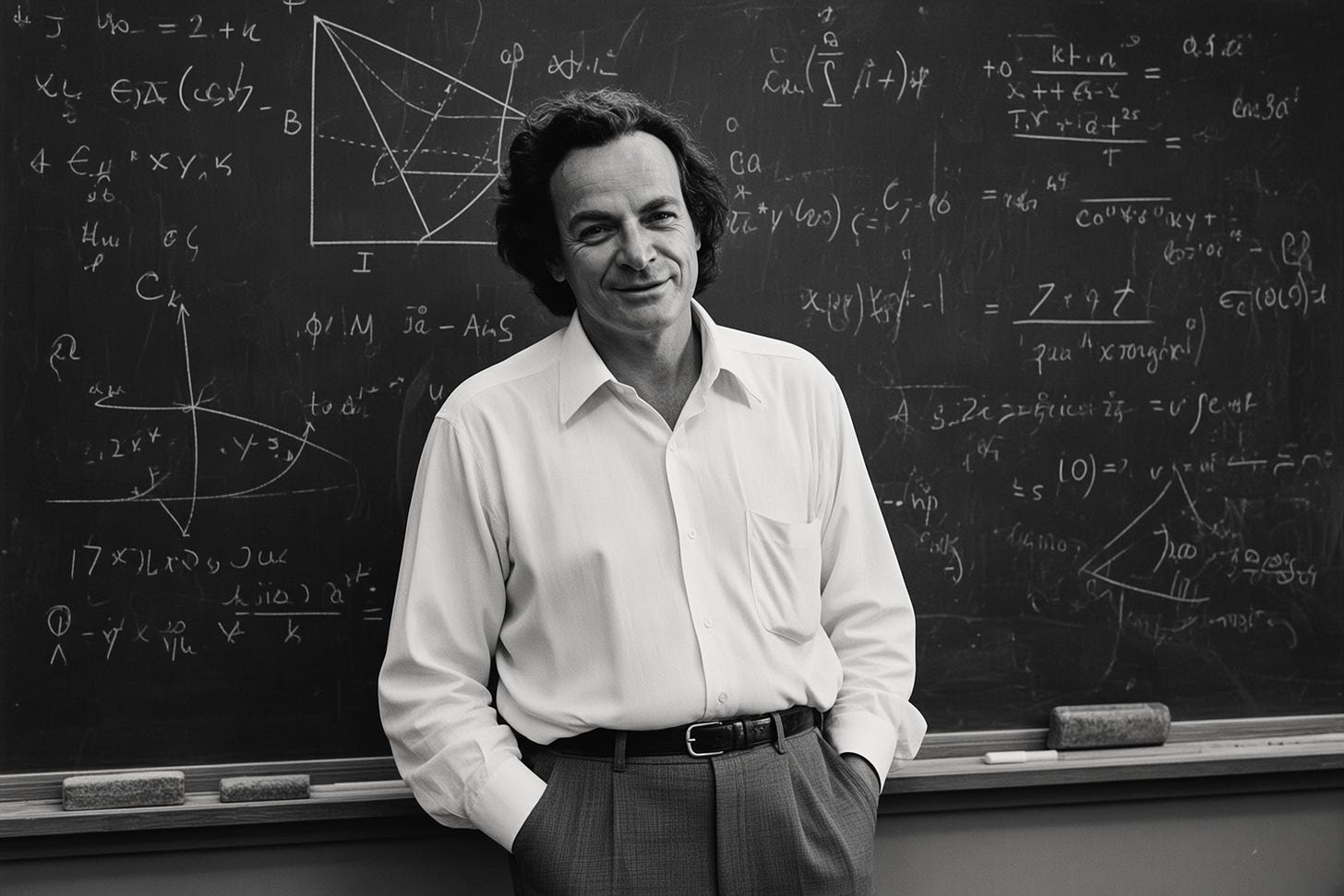
Richard Feynman spent a lifetime asking the question other people skipped: How do you know?
He was one of the great physicists of the last century—he helped build the atomic bomb, shared a 1965 Nobel Prize for explaining how light and matter interact, and invented the diagrams physicists still use. He demonstrated what doomed the Challenger on live television, compressing a piece of O-ring rubber in a clamp and dropping it into ice water. But what he cared about most was teaching people to think, and he had no patience for answers that only sounded right.
Which is why, in 1964, he did something no one else on the California textbook commission bothered to do. He actually read the books.
Three hundred pounds of them arrived at his house. He built a shelf to hold them and started reading, every page, every problem set.
One publisher had missed the deadline. So they sent their book in with nothing inside. Blank pages between the covers. And it got rated. Not poorly, either. It scored a little higher than two finished textbooks from the same publisher.
No one had opened it. The other commissioners passed the books to committees, gathered scores, and averaged them. The averaging did the rest. A book with nothing in it sailed through, because the people deciding what children would learn never looked.
That is what accepting the first answer looks like. And we are all doing it now, faster than ever.
When speed starts to feel like truth
Ask AI a question and the answer arrives in about a second. That speed does something quiet to us. The faster a reply arrives, the more finished it feels. So we stop. We take it. We move to the next thing.
A confident answer can still be wrong. But fluency is persuasive. It reads like someone who knows, so we grade it like someone who knows.
We become the averaging committee, and the machine is very good at filling pages.
Speed only feels like accuracy.
A word dressed as an answer
Feynman found the same flaw inside the books that weren’t blank. One first-grade science text asked what makes a windup toy go. The answer it printed: energy makes it go.
He took it apart. Try explaining the toy without the word “energy.” You can’t. The child learns a word and nothing more: nothing about the spring that stores force, nothing about the gears that let it go. A label had been handed over and dressed up as understanding.
AI does this all day. Ask it something hard, and you often get a smooth paragraph that names the thing without explaining it—a word standing in for the understanding. If you can’t say the answer back in your own words, you didn’t get an answer. You got a label.
The question that silenced the room
In the early 1950s, Feynman spent a year teaching physics in Brazil. His students could recite everything. They had memorized every formula. Then he would reword a question, the same idea in different words, and the room went quiet. Their knowledge worked only through the exact door they had memorized. Change the entrance, and it disappeared.
He described them as walking books. Look up the right keyword and the answer is there; search a different word for the same idea, and you get nothing. He had crossed the world and found a system that produced people who could pass any exam and do no science.
That is a fair description of the tool on your desk. AI is the walking book at planetary scale. It has read everything and understood none of it. Ask it what has already been answered and it shines. Ask it something genuinely new, where the facts argue with the textbook, and it stalls. A machine can replace the memorizer. The person who thinks from scratch is harder to replace.
Why the answer looks smarter than it is
In 1974, Feynman told Caltech’s graduates about islands in the South Pacific. During the war, planes had landed there carrying food and supplies. After the soldiers left, the islanders wanted the planes to come back. So they built runways out of dirt, carved headphones from wood, raised bamboo antennas, and put a man in a hut to wave the planes down. Every visible step was right. No planes landed.
He called it cargo cult science. The form was perfect. The one invisible thing that makes planes land was missing.
A fluent AI answer can be that runway. It has the shape of knowledge, the confident tone, the tidy structure. And sometimes nothing lands. The only way to know is to check what sits underneath, which is the very step the speed tempts you to skip.
What happens when you refuse the first answer
Feynman left behind a habit simple enough to use this afternoon. He taught his Brazilian engineers to estimate before they calculated. Guess the answer first. Then run the math. If the two are far apart, something is wrong—usually the math, and your gut caught it.
The same move works on AI. Refuse the first answer. You can’t yet tell whether it’s right, so make it earn its place:
Ask what it left out.
Ask it to argue the other side.
Rephrase your question; see if the answer survives the rewording.
Check it against the one or two things you already know to be true.
None of this takes long—thirty seconds, most of the time. Feynman’s first rule for scientists fits here too: you must not fool yourself, and you are the easiest person to fool. A machine built to sound certain is very good at helping you do exactly that.
The habit worth keeping
Here is why this matters more now than it did in 1964. When everyone can generate an answer in a second, having the answer stops being the advantage. Knowing which answer deserves your trust becomes the rare skill.
Cheap intelligence makes discernment the expensive part.
There is an odd confirmation of this in the news. Europe’s new AI rules, and the AI companies themselves, are moving to mark machine-made text so people can tell what a human actually authored. Strip away the mechanics, and the message is the one Feynman spent his life making: the human in the loop is the point. Your standard, your effort, your willingness to check—that is the thing no model can give you, and no watermark can supply.
The blank book passed because nobody looked. The first answer passes for the same reason. The remedy hasn’t changed since 1964: refuse to let the answer do your thinking for you.