You didn’t vote for this. Neither did I.
Somewhere in this country right now, an algorithm is deciding whether a veteran’s benefits claim gets approved, or what evidence a public defender’s software surfaces in a case that isn’t yours yet, but could be. Nobody asked you first. Nobody asked me either. And the rulebook running that decision got worse, quietly, while everyone watched a different fight.
I’ve spent the last few years tracking this kind of quiet procedural shift, because headlines cover the fight and miss the paperwork.
Here’s how we got there, and why the part nobody’s still watching matters more than the headlines.
Two legitimate arguments. One question nobody asked
In February, the Pentagon told Anthropic to drop two protections built into Claude: no mass domestic surveillance of Americans, no fully autonomous weapons making lethal decisions without a human in the loop. Anthropic said no.1
That refusal deserves context most coverage skipped. Anthropic was the first frontier AI company to run models on U.S. government-classified networks and at National Laboratories. By its own account, it had never once objected to a specific lawful military operation. The dispute wasn’t about cooperation. It was about these two categorical lines.
Both men were arguing from a real position. Hegseth wanted a military that isn’t second-guessed by a private company’s conscience. Anthropic wanted two specific lines it wouldn’t cross regardless of the customer. Neither position is unreasonable on its own.
In a detailed post, he called Anthropic’s position “arrogance and betrayal,” accused the company of “duplicity,” and said it was using “defective altruism” to impose “Silicon Valley ideology” and a “veto power” over military decisions that belonged to the Republic, not to a corporate ethics board. He wanted full, unrestricted access to Claude for every lawful purpose in defense of the country.2
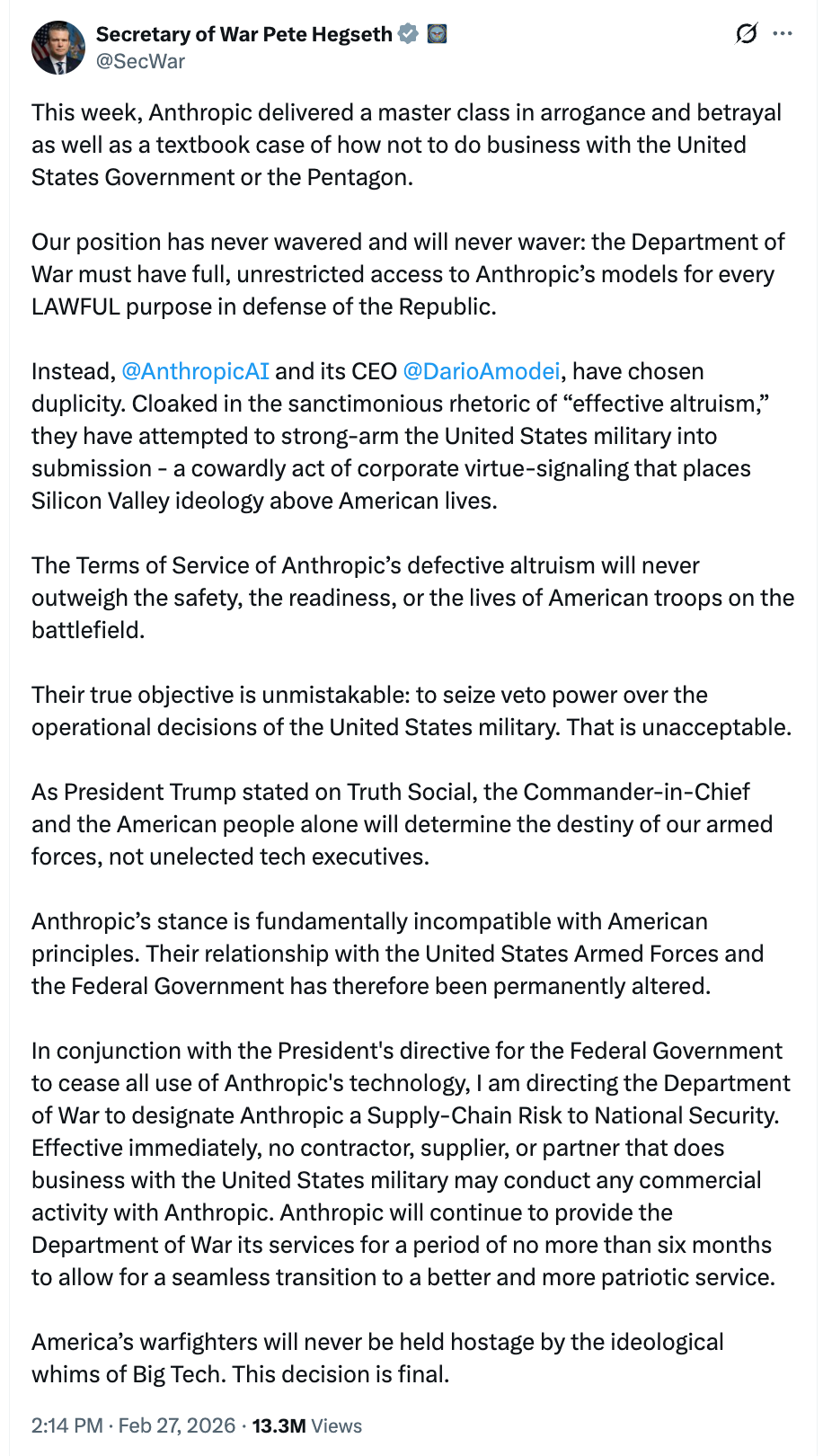
Within the hour, the White House ordered every federal agency to stop using Anthropic’s technology. Hegseth designated the company a “supply chain risk,” a label built for foreign adversaries and never applied to an American firm. Anthropic sued.3
What happened after the cameras left?
A federal judge blocked most of the Pentagon’s order in March, concerned the whole move looked like retaliation.4 An appeals court let the designation stand anyway in April, at least for the systems Anthropic sold directly to the Department of War.5 As of this writing, the case sits in that limbo: enforced, appealed, unresolved.
Most coverage stopped there. The court fight looks like the whole story.
It isn’t.
Three vendors said yes
While the lawyers argued, the Pentagon didn’t wait for Anthropic to fold. It went shopping and found what it needed: a multi-vendor rollout through GenAI.mil running models from xAI, OpenAI, and Google, none of which required the same two exceptions Anthropic wouldn’t give up.6
Read that twice. The two protections that started this fight, the ban on domestic surveillance and the ban on fully autonomous weapons, never became the industry floor. They became the thing one company held out for while the government found three others willing to skip them.
Anthropic’s commercial revenue kept climbing through it all, past $30 billion. Losing the government contract barely registered on the balance sheet. Nobody’s bottom line forced a reckoning. Nobody’s ballot did either.
This was never a fight about whether Anthropic wins or loses. It’s about what quietly replaces the loser.
Where this actually lands: your benefits, your case file, your hospital
You don’t work at the Pentagon. You’ll still live inside whatever these systems decide is normal.
A veteran’s benefits claim is pre-screened by a model built under rules different from the ones Anthropic refused to accept. A public defender’s case-management software runs on a framework nobody at the courthouse chose. A hospital’s triage tool quietly inherits whichever vendor won the government contract this quarter.
None of that required a new law. It required a procurement decision made by people you’ve never heard of, in a meeting you were never invited to.
The question no appeal can answer
Say the injunction holds on appeal. Say it doesn’t.
Either way, the deeper problem survives the ruling: the rules governing what AI can do to an American citizen are still written by whichever private company says yes to the contract, not by anyone that citizen elected.
A court can decide who was right about one supply-chain statute. No court is deciding who gets to write the next constitution for a technology none of us voted on.
What a sovereign citizen does next
No corporation or courtroom was ever going to hand you sovereignty. That was never their job.
A self-governing people can’t outsource the watching to a company’s conscience or a judge’s docket. Every time a new system touches your benefits, your case file, or your kid’s classroom, the question is the same one, regardless of who wins in D.C.: who wrote the rule, and can you still vote it out?
That question doesn’t expire when the appeal does.
The court case will resolve eventually. The vulnerability won’t.
Whoever wins this fight, the next contract still gets written by someone you didn’t elect, for a system you’ll still have to live under.